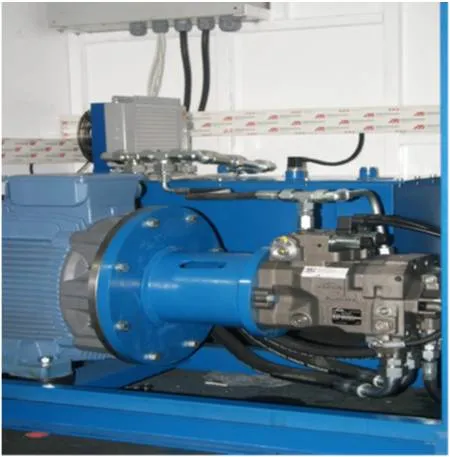
We clean hydraulic circuits by pickling and flushing before commissioning, and report the ISO 4406 cleanliness class by particle counting. Flushing units and particle counters are also available for rent.
A large share of hydraulic failures come from contamination. Swarf, scale and dust left from welding and installation wear the pump, valve spools and cylinder seals on first start-up. Cleaning the circuit before normal operation prevents this damage and protects production efficiency.
02
Pickling
In the circulation method, pickling is done after the pipe circuits are installed in place and connected to each other. The acid solution is pumped through the pipes to dissolve scale and rust; the line is then neutralised, rinsed and protected against corrosion.
Sensitive equipment (pumps, valves, cylinders, accumulators) is kept out of the pickling circuit; the lines are bridged to form a closed loop.
03
Oil flushing
The flushing unit passes oil through the line above the working flow rate, in turbulent flow. On each pass the oil goes through fine filters, while a particle counter measures cleanliness on line. When the target class is reached and the reading is stable, the process is ended and a report is issued.
04
Oil measurement and rental
On running systems we measure the oil cleanliness class on site and tie filter and oil change decisions to data. For shipyards and plants with their own crews we rent out flushing units and particle counters.
02Target cleanliness classes
The most sensitive component decides.
The ISO 4406 code gives the particle counts above 4, 6 and 14 microns as three numbers. The lower the numbers, the cleaner the oil.
Component
ISO 4406 target
Servo valves
16/14/11
Proportional valves
17/15/12
Vane and piston pumps and motors
18/16/13
Directional and pressure control valves
18/16/13
Gear pumps and motors
19/17/14
Flow control valves, cylinders
20/18/15
New, unused oil
20/18/15
03From the workshop and the field
04Frequently asked
Questions, answers.
What is flushing?
Flushing is washing hydraulic pipe circuits with high-flow, filtered oil circulation before commissioning. The aim is to remove particles left from installation and bring the oil to the target cleanliness class.
What is the difference between pickling and flushing?
Pickling is a chemical process that dissolves scale and rust on the pipe bore. Flushing is a mechanical wash that carries loose particles to the filter with the oil flow. On welded carbon steel lines pickling comes first, then flushing.
To which cleanliness class should a system be flushed?
The most sensitive component decides. Typical ISO 4406 targets are 16/14/11 for servo valve systems, 17/15/12 for proportional valves and 18/16/13 for general directional valve systems.
How long does flushing take?
It depends on line length, pipe size, initial contamination and the target class; a small circuit is done in hours, a large ship system in days. After a survey we give a time and method plan.
Do you rent flushing units?
Yes. We rent flushing units and particle counters, with operator and supervisor support if required.
A cylinder size, a power unit capacity or a piping job on board: tell us what you need and our engineering team will come back with a technical solution and a quote.